 Pilots for HIMS Reform
The HIMS Medical-Necessity Waiver: When Aviation Policy Overrides Clinical Placement Standards
September 7, 2026 · Pilots for HIMS Reform
Aviation can justify extraordinary safeguards. It does not erase the basic rules of medicine: diagnosis should drive treatment, treatment intensity should be individualized, clinicians should exercise independent judgment, and records submitted for payment should truthfully describe why care was provided.
A HIMS response released from the National Academies' congressionally directed review raises a consequential question. HIMS described airline arrangements with selected treatment centers allowing a “waiver of medical necessity criteria and ASAM treatment criteria” so pilots could be admitted to 28-plus-day treatment programs. The same response said acceptance of intensive outpatient treatment or less was “extremely rare” among airlines or the FAA.
Why would a safety program need treatment centers willing to waive the clinical criteria ordinarily used to decide whether residential treatment is medically necessary—and how were those admissions documented and paid for?
The document in HIMS's own words
This is not a critic's description. It comes from HIMS's written response to the National Academies.

The submission also described a 28-day inpatient episode as costing roughly $30,000 before later continuing-care and monitoring costs.
It appears again in treatment-center selection
In the same submission, HIMS identified “willingness to waive medical necessity criteria” among treatment-center selection factors. It also identified willingness to provide “COMPLETE medical records to HIMS AME.”
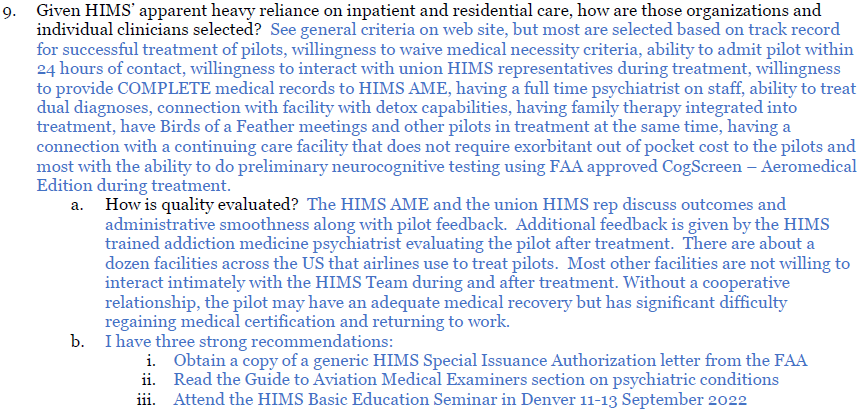
None of this proves that a particular pilot received medically unnecessary treatment, that an insurer was deceived, or that a diagnosis was falsified. Residential care can be appropriate for severe substance use disorder, withdrawal risk, repeated relapse, serious psychiatric comorbidity, or an unstable recovery environment. But the documents create a legitimate oversight question: was treatment intensity determined by individualized clinical need, or was a predetermined occupational expectation driving the clinical pathway?
What medical necessity and ASAM criteria are supposed to do
Medical necessity addresses whether a service is clinically appropriate for a particular patient, diagnosis, intensity, setting and duration. ASAM placement criteria are designed to match a patient's multidimensional needs to an appropriate level of addiction care. The National Academies' 2023 consensus report found that HIMS most commonly expected pilots meeting FAA substance abuse or dependence definitions to undergo residential treatment regardless of substance-use-disorder severity, and recommended individualized treatment based on contemporary evidence.
Clinical model: diagnosis → severity → placement assessment → level of care.
Concern raised by the record: pilot/HIMS status → expected residential treatment → facility able to accommodate the requirement.
Could the waiver itself be legal?
Yes. An airline may lawfully require and pay for care beyond what a health plan would ordinarily cover. An insurer may knowingly approve an exception. If everyone knows the treatment exceeds ordinary medical-necessity criteria, the records say so, and no payer is misled, the arrangement is not automatically fraudulent.
The legal picture changes if a provider believes outpatient care is clinically appropriate but nevertheless represents residential treatment as medically necessary to obtain payment. If a federal payer is involved, the False Claims Act, 31 U.S.C. § 3729, can impose civil liability for knowingly presenting a false claim or knowingly using a materially false record in connection with government payment. The Department of Justice regularly applies the statute in healthcare-fraud matters.
The present record does not establish insurance fraud, a False Claims Act violation, or criminal wrongdoing by HIMS, FAA, ALPA, an airline, an insurer, a treatment center, or any individual. Those conclusions require case-specific clinical records, billing records, payer information and evidence of the required mental state.
The paper trail that can answer it
The issue is testable. Investigators should compare the initial assessment, ASAM placement recommendation, treating clinician's recommended level of care, insurer authorization and utilization review, any HIMS, airline or FAA minimum-treatment requirement, diagnosis and procedure codes submitted for payment, admission and continued-stay notes, explanation of benefits, identity of the payer, and communications showing whether clinicians were free to recommend less intensive care.
Clinical recommendation: outpatient or IOP.
Occupational requirement: 28-plus-day residential care.
Insurance representation: residential treatment medically necessary.
If those records existed in the same case, the discrepancy would demand explanation. P4HR has not established that this occurred in any particular case.
Parity, disability law, privacy and consent
Mental-health parity: Federal parity law regulates medical-necessity and utilization-management standards for mental-health and substance-use benefits. But this issue may involve an occupational system demanding more treatment than ordinary criteria require, so the sharper questions are truthful billing, financial responsibility and plan administration. See Department of Labor parity guidance.
Disability law: Pilots are safety-sensitive workers, and legitimate medical safeguards are permitted. But EEOC guidance emphasizes job-related, business-necessary inquiries and individualized assessment based on objective evidence. FAA certification authority, airline employment requirements, treatment-center medical judgment and HIMS monitoring roles should not be blurred together.
Privacy: HIMS's reference to complete medical records raises a separate question. HIPAA generally regulates covered providers and plans rather than employers acting as employers. HHS explains that a provider generally cannot disclose health information directly to an employer without authorization unless another legal provision permits it. Substance-use treatment records may also receive additional protection under 42 C.F.R. Part 2. See HHS guidance.
Consent: A signed authorization can be legally valid while still raising an ethical question when refusal may end a pilot's pathway back to certification or employment. The more career leverage exists, the more important it becomes to distinguish what is medically recommended from what is occupationally required.
The ethical problem may be clearer than the legal one
A clinician treating a safety-sensitive professional can properly consider public safety. But the clinician still owes duties of honest diagnosis, independent judgment, appropriate treatment selection and meaningful informed consent. If treatment-center eligibility is influenced by willingness to waive ordinary placement criteria, the system risks rewarding accommodation of an occupational program rather than independence of medical judgment.
A treatment center must remain free to say: “This pilot does not clinically require residential treatment.” If that conclusion creates a risk of losing HIMS referrals or blocking the pilot's certification pathway, the conflict deserves independent oversight.
The evidence problem extends beyond treatment
HIMS has long been promoted with strong claims about abstinence, return to flight and economic value. Yet the National Academies documented that it could not obtain the underlying HIMS database needed to independently validate those claims. The committee sought access, proposed confidentiality protections, proposed allowing ALPA to run requested queries, and noted after reviewing the FAA-ALPA contract that FAA owned the data. The report ultimately concluded that HIMS effectiveness claims could not be substantiated from the available evidence.
That does not prove HIMS is ineffective. It means a program that can impose intensive treatment and years of monitoring has not provided the level of independent outcome validation such authority should demand. The record can be explored at the FAAHIMS.wiki primary-source archive and the National Academies project page.
FAA knows career consequences can deter care
FAA-authored material in the National Academies record discusses pilot healthcare avoidance and the tendency to discount symptoms perceived as threatening the ability to earn a living. That creates a safety paradox: the more severe, expensive and career-disruptive pilots expect disclosure to become, the greater the incentive to delay care or conceal symptoms.
A safety system should be judged not only by how aggressively it controls pilots after identification, but by whether pilots trust it enough to seek help before a problem becomes a safety event.
Questions that now require answers
- Does FAA currently require or expect approximately 28 days of residential treatment for any category of pilot?
- When will FAA accept outpatient or intensive outpatient treatment?
- What did “waive medical necessity” mean operationally, and which airlines and facilities used these arrangements?
- Who paid when a pilot did not satisfy a health plan's ordinary placement criteria?
- Were insurers informed when an occupational requirement exceeded the independent clinical recommendation?
- Were clinicians free to recommend a lower level of care without affecting a pilot's return-to-flight pathway?
- Were pilots told which treatment elements were medically recommended and which were occupationally required?
- What complete medical records are transmitted to HIMS AMEs, and what limits apply to use, retention and redisclosure?
What reform should look like
- Independent clinical placement based on documented, evidence-based assessment.
- Separation of clinical and occupational requirements in the medical record.
- Transparent payment when an employer or regulator requires care beyond ordinary medical necessity.
- Clinical independence for treatment centers and evaluators.
- Meaningful informed consent about records, alternatives and career consequences.
- Independent validation of HIMS outcomes using auditable data.
- Published scientific rationale for any FAA treatment standard that exceeds ordinary clinical practice.
Safety should be rigorous. Treatment should be evidence-based. Medical records should be truthful. Clinical judgment should be independent. No pilot should have to wonder whether a doctor is prescribing what the patient needs—or what the system demands.
The core principle
The question is not whether pilots may be held to higher safety standards. They can. The question is whether higher safety standards have been converted into predetermined medical treatment standards—and whether the financial, ethical and legal systems surrounding those decisions are transparent enough to prove that pilots are receiving medically honest care.
Research and legal note: This article identifies policy, clinical, ethical and legal issues raised by documentary evidence. It does not accuse any identified individual, airline, union, treatment center, insurer or government official of fraud or criminal wrongdoing. Whether any treatment episode or claim violated law depends on facts not contained in the present record.
Document note: P4HR reviewed the National Academies public-access archive file by file. The two HIMS RFI exhibits above were verified against the document contents; highlighting is P4HR's and the underlying text is otherwise unaltered.