AEROPath
An Evidence-Based Alternative Aviation Medical Pathway
AEROPath is a proposed FAA-recognized alternative pathway for airmen whose conditions require enhanced evaluation, treatment, monitoring, or recovery oversight. It is designed to preserve rigorous aviation-safety protections while replacing unnecessary institutional rigidity with published standards, qualified independent clinicians, individualized risk assessment, measurable outcomes, transparent decision-making, bounded regulatory authority, and enforceable due process.
The AEROPath Standard
Enhanced monitoring may continue only when supported by specific, current, individualized, and medically competent evidence demonstrating a materially elevated aviation-safety risk that cannot reasonably be addressed through a less restrictive alternative.
What AEROPath Is — and Is Not
AEROPath is not self-directed medical certification, weakened safety oversight, or a way for an airman to avoid legitimate treatment, testing, or monitoring. The FAA would retain its statutory certification authority, but that authority would operate within published evidentiary standards, review deadlines, proportionality requirements, independent review, and enforceable procedural safeguards.
AEROPath is also not a proposal to abolish HIMS. HIMS may remain available when it is the appropriate pathway. AEROPath creates a parallel FAA-recognized option governed by the same aviation-safety objective, but using transparent, evidence-based, individualized standards and meaningful limits on government discretion.
An airman cannot decide alone when testing, monitoring, or restrictions end.
Providers must meet published qualification and conflict-of-interest standards.
Reduced oversight must be earned through objective evidence and measurable milestones.
FAA decisions must satisfy published standards, evidentiary burdens, deadlines, and independent review.
AEROPath at a Glance
AEROPath is designed as a structured progression: individualized evaluation and care, monitoring proportional to current risk, meaningful rights checkpoints, measurable step-down milestones, and a genuine route to unrestricted certification. If new safety evidence emerges, the pathway can re-evaluate and proportionately re-escalate oversight.
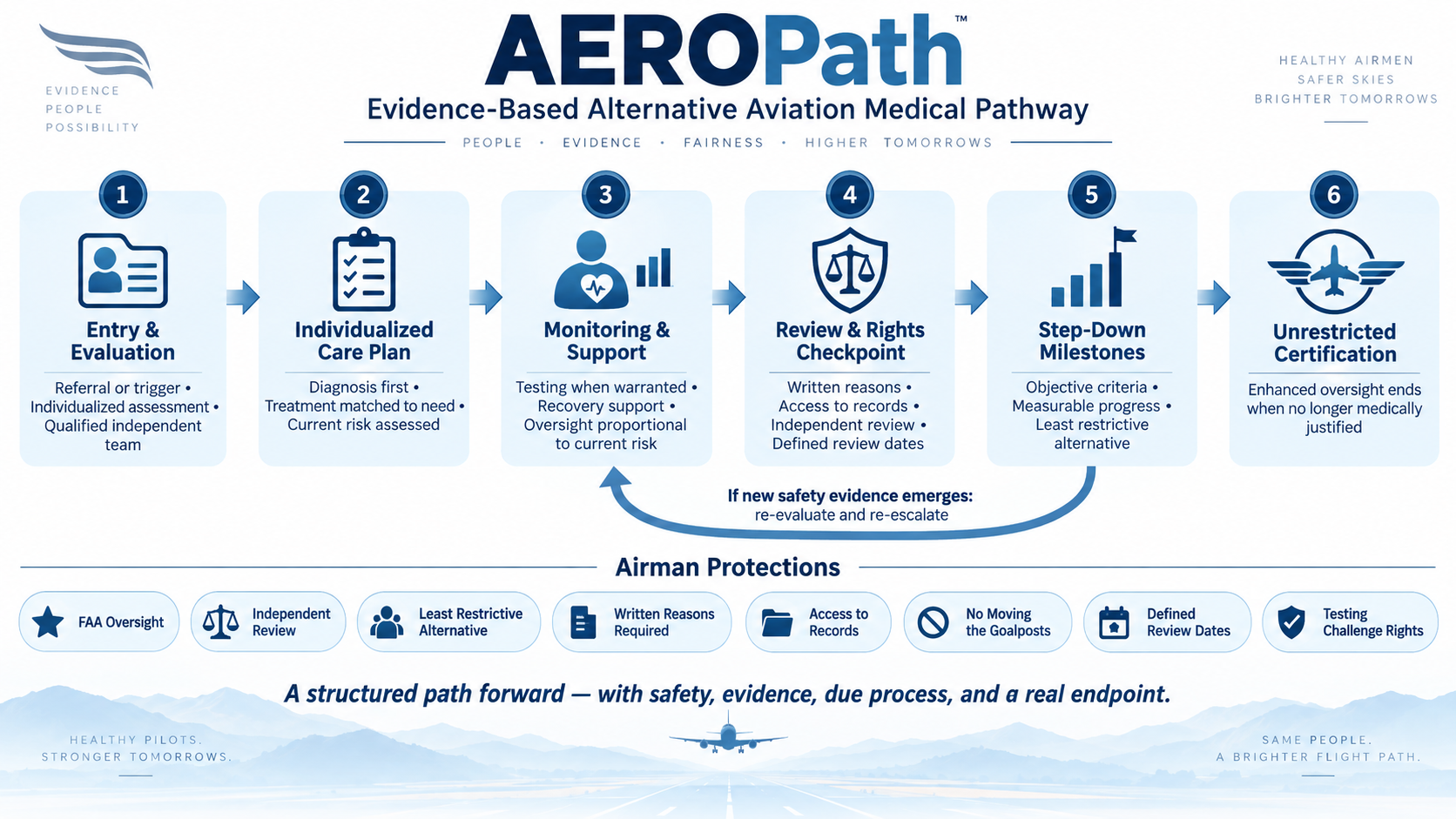
How AEROPath Would Work
1. FAA Authority — Bounded by Published Rules
The FAA would establish national minimum standards for provider qualifications, diagnostic requirements, testing, treatment planning, monitoring, documentation, conflict safeguards, reporting of safety-significant events, return-to-duty evaluation, step-down criteria, independent review, and unrestricted certification. Neither an airman nor an individual clinician could unilaterally override those standards.
At the same time, the FAA could not impose or extend heightened requirements through unpublished criteria, generalized concern, institutional habit, or a past diagnosis standing alone. Any restriction beyond the published baseline would require a documented, individualized medical and aviation-safety justification.
2. Qualified Independent Medical Teams
The airman would receive care and evaluation from appropriately qualified professionals who meet published FAA standards. Depending on the condition, the team could include an AME or HIMS AME, addiction-medicine or addiction-psychiatry physician, psychiatrist, psychologist or neuropsychologist, treating physician, behavioral-health clinician, toxicology specialist, or other relevant specialist.
Choice does not mean unrestricted choice. AEROPath allows reasonable access to qualified professionals outside closed or exclusive networks while requiring competency, independence, documentation, and safety reporting.
3. Conflict-of-Interest Safeguards
AEROPath would apply conflict standards to both institutional relationships and inappropriate personal relationships. Providers with significant personal, financial, supervisory, or other conflicts that could compromise independent judgment should not serve in decisive evaluative roles. Safety should depend on standards and evidence — not who someone knows.
4. Diagnosis First, Program Second
AEROPath begins with an individualized evaluation of diagnosis, severity, functional impairment, relevant history, treatment history, current condition, demonstrated stability or recovery, relapse or recurrence history, protective factors, occupational considerations, and current aviation-safety risk. The resulting evidence determines the intervention.
The program should follow the diagnosis. The diagnosis should not be forced to fit the program.
5. Individualized Treatment
Residential, partial-hospitalization, intensive outpatient, outpatient, psychotherapy, medication, peer-support, recovery-support, or other interventions may be appropriate depending on the individual case. When intensive treatment is required, the airman should receive it. When a less intensive level of care is medically appropriate, a higher level should require a documented clinical or aviation-safety justification.
Recovery Support and Government Surveillance Are Different Questions
AEROPath recognizes that recovery may be lifelong. An individual may benefit indefinitely from meetings, therapy, sponsorship, peer support, medication, medical follow-up, or other voluntary supports.
But lifelong recovery does not automatically establish the medical necessity for lifelong government-directed surveillance.
AEROPath therefore asks two separate questions: What does the individual need for continued health and recovery? And what additional oversight does the FAA currently need to protect aviation safety?
6. Monitoring Matched to Current Risk — Using the Least Restrictive Effective Measure
AEROPath does not impose a universal fixed monitoring period. Monitoring intensity and duration would be based on current evidence, including diagnosis and severity, time since treatment or last significant event, demonstrated stability, relapse history, testing history, treatment adherence, clinical observations, occupational risk, relevant comorbidities, and other evidence-supported risk factors.
Where more than one intervention can adequately address a demonstrated safety risk, the FAA should use the least restrictive effective alternative. If periodic clinical follow-up adequately addresses the identified risk, a substantially more burdensome testing or treatment regime should require a specific explanation of why the less restrictive option is insufficient.
Same safety standard. Individualized means of satisfying it.
7. Rigorous, Defensible Testing
When toxicology or biomarker testing is required, it must remain meaningful and appropriately unpredictable. National standards should address test selection, frequency, randomization, notification, collection timing, missed or delayed tests, chain of custody, laboratory accreditation, confirmation testing, specimen validity, quantitative interpretation, incidental exposure, medical confounders, and disputed results.
Abnormal results should be taken seriously. They should also be interpreted according to valid science rather than treated as infallible merely because they came from a laboratory.
8. Safety Triggers and Re-Escalation
AEROPath includes clear mechanisms to increase oversight when risk increases. Confirmed relapse, prohibited-substance use, material treatment noncompliance, repeated missed or deliberately delayed testing, test manipulation, significant clinical deterioration, falsification or intentional nondisclosure, or a new safety-relevant diagnosis could trigger additional evaluation, increased testing, treatment, temporary removal from flight duties, or other medically appropriate action.
Any re-escalation should identify the triggering evidence, the increased requirement imposed, the reason a less restrictive response would be inadequate, and the criteria and review date for returning to a lower level of oversight.
Step-down is earned through evidence. Re-escalation occurs when evidence warrants it.
9. Published Step-Down Criteria and a Burden Shift
Every airman subject to enhanced monitoring should be able to understand the standards governing progression. Relevant milestones could include sustained clinical stability, treatment completion, specified periods without relapse or recurrence, satisfactory testing, favorable clinical evaluations, occupational stability, documented compliance, and absence of identified high-risk indicators.
Before those milestones are satisfied, the airman bears the responsibility to demonstrate compliance and progress. Once the published milestone for step-down or unrestricted review is satisfied, the burden shifts. Continued enhanced oversight should then require the FAA to identify specific, current, individualized evidence of a materially elevated aviation-safety risk and explain why a less restrictive alternative is inadequate.
A historical diagnosis, prior treatment episode, or generalized concern about relapse would not, by itself, satisfy that burden.
10. A Defined Path to Unrestricted Certification
AEROPath must include a genuine endpoint. Airmen should not remain indefinitely in heightened surveillance solely because they once qualified for heightened surveillance.
After the applicable unrestricted-certification milestones are satisfied, continued enhanced monitoring may continue only when supported by specific, current, individualized, and medically competent evidence demonstrating a materially elevated aviation-safety risk that cannot reasonably be addressed through a less restrictive alternative.
The question should be: What current evidence demonstrates that this individual still requires enhanced government oversight? Not simply: What diagnosis did this individual receive years ago?
No Moving the Goalposts
When the FAA establishes the criteria an airman must satisfy for progression, step-down, or unrestricted review, those criteria should govern the decision. The agency should not add new requirements after the airman satisfies the stated standards unless genuinely new, material, safety-relevant evidence arises.
If new evidence requires a change, the FAA should identify that evidence in writing, explain why it changes the risk assessment, identify the additional requirement, and establish a new review date. Unpublished expectations and retroactive requirements should have no place in a high-stakes medical-certification system.
Mandatory Review Dates — and a Remedy for Agency Delay
Every enhanced-monitoring requirement should carry a defined expiration or mandatory review date. Heightened oversight should not continue indefinitely merely because no one at the agency acted on the file.
If the FAA misses a required review deadline, the airman should receive automatic expedited independent review. Where the governing milestone has already been satisfied and there is no documented emergency safety finding, the framework should provide a presumptive or automatic step-down rather than allowing administrative delay to preserve the more restrictive status quo by default.
An emergency exception should require a specific written safety finding and prompt independent review. Delay should never function as an unreviewable form of continuing regulation.
Due Process Is a Safety Feature
AEROPath would require understandable written reasons for significant adverse decisions, timely access to the complete material record, a meaningful opportunity to respond, defined agency timelines, and independent review outside the original decisional chain for substantial disputes involving diagnosis, treatment requirements, testing interpretation, continued monitoring, step-down eligibility, re-escalation, or unrestricted certification.
Written reasons should identify the evidence relied upon, the published standard applied, the specific requirement the airman has not satisfied, the next measurable milestone, and the date of the next review. A conclusory statement that “continued monitoring is warranted” should not be sufficient.
Independent Review Must Actually Be Independent
Independent review should not simply mean referral to another official within the same decisional chain. Significant disputes should be eligible for review by a genuinely independent aeromedical body or panel whose members did not participate in the original decision and have no material institutional or financial conflict concerning the outcome.
The reviewing body should have access to the full record, authority to obtain relevant expert input, and authority to affirm, modify, reverse, or remand the disputed requirement. The FAA should be required to defend the medical and evidentiary basis for continued restrictions once the applicable burden has shifted.
Expedited Remedy for Overreach
An airman should have access to expedited review when the FAA allegedly relies on undisclosed criteria, refuses required record access, misses a mandatory deadline, imposes requirements inconsistent with published standards, continues monitoring without the required evidence, disregards a qualified medical recommendation without explanation, or retaliates against an airman for exercising protected review rights.
The remedy must be capable of changing the airman’s status in a meaningful timeframe. Due process that arrives only after years of unnecessary restriction is not an adequate safeguard.
AEROPath Airman Bill of Rights
Every airman subject to enhanced medical oversight should have:
- The right to published standards before being required to satisfy them.
- The right to timely access to the complete material record used in a certification or monitoring decision.
- The right to respond to adverse evidence before a significant non-emergency restriction becomes final.
- The right to qualified independent medical opinions from professionals meeting published competency standards.
- The right to written reasons identifying the evidence, standard, decision, next milestone, and review date.
- The right to defined timelines for FAA action and review.
- The right to objective step-down and exit criteria.
- The right to the least restrictive monitoring consistent with the demonstrated aviation-safety risk.
- The right to challenge laboratory, toxicology, and testing evidence through scientifically valid confirmation and review procedures.
- The right to genuinely independent review outside the original decisional chain.
- The right to be free from unpublished, retroactive, or shifting requirements absent genuinely new safety-relevant evidence.
- The right to unrestricted certification when enhanced oversight is no longer supported by the required current evidence.
- The right to be free from retaliation for seeking records, obtaining an independent opinion, disputing evidence, requesting review, or exercising any right provided by the pathway.
Clinical Independence
Qualified clinicians should be able to exercise honest medical judgment without pressure to reach a predetermined institutional conclusion. FAA standards should define the safety requirements. Qualified clinicians should apply medicine to the individual patient — including recommending escalation when risk increases and reduction of restrictions when evidence demonstrates sustained stability.
If the FAA rejects a material recommendation from a qualified clinician, the agency should explain the medical basis for doing so and identify the evidence supporting the contrary conclusion.
National Outcome Data and Continuous Improvement
AEROPath should include de-identified outcome reporting sufficient for independent evaluation. Relevant aggregate measures could include diagnoses, treatment pathways, monitoring duration, return-to-duty rates, relapse or recurrence, testing outcomes, adverse events, certification outcomes, step-down timing, independent-review outcomes, agency-deadline compliance, and unrestricted-certification outcomes.
The same transparency principle should apply to every FAA-recognized enhanced monitoring pathway. Programs whose effectiveness is invoked to justify substantial medical requirements should be capable of independent evaluation.
Transparency is part of safety.
AEROPath and HIMS
| Question | AEROPath Position |
|---|---|
| Does AEROPath eliminate HIMS? | No. It creates a parallel FAA-recognized evidence-based pathway. |
| Does the airman control certification? | No. The FAA retains certification authority, but must exercise it under published standards, evidentiary burdens, deadlines, and review rights. |
| Can an airman pick any doctor? | No. Providers must satisfy published qualification and conflict standards. |
| Does monitoring automatically end after a set number of months? | No. Oversight is matched to current individualized risk and objective milestones, with mandatory review dates. |
| Can the FAA keep someone in enhanced monitoring indefinitely? | Not merely by preserving the status quo. After applicable milestones are met, the FAA must justify continued enhanced oversight with specific current evidence and show why a less restrictive alternative is inadequate. |
| Can oversight increase again? | Yes. New material evidence of increased risk can trigger re-evaluation and proportionate re-escalation, with written reasons and a new review date. |
| What if the FAA misses a deadline? | The airman receives expedited independent review, with presumptive or automatic step-down where the governing milestone is satisfied and no documented emergency safety finding exists. |
| Can the FAA add new requirements after the airman complies? | Only when genuinely new, material safety-relevant evidence justifies the change, with written explanation and a new review date. |
| Is unrestricted certification guaranteed? | No. It becomes available when published criteria are met and the FAA cannot demonstrate the evidence required to justify continued enhanced oversight. |
Eight Principles
Qualified professionals.
Independent medical judgment.
Individualized risk assessment.
Rigorous and defensible monitoring.
Published standards and measurable milestones.
Least-restrictive, evidence-based government oversight.
Enforceable due process and independent review.
A genuine pathway to unrestricted certification when enhanced oversight is no longer medically justified.
AEROPath does not ask the FAA to trust an airman blindly, and it does not ask an airman to trust the FAA blindly. It asks both sides to operate under evidence, qualified medicine, transparent standards, measurable outcomes, reviewable decisions, and enforceable safeguards.
Where the evidence demonstrates continuing risk, AEROPath preserves proportionate continuing oversight. Where the evidence demonstrates sustained stability and the FAA cannot meet the required burden for continued enhanced surveillance, the system must permit step-down and ultimately unrestricted certification.
Safety requires accountability from the airman. A fair system also requires accountability from the regulator.